Answer the questions that hold buyers back
Product templates shaped around variants, bundles, ingredients, sizing, subscriptions, specifications, or whatever a confident purchase requires.
Custom Shopify theme development
We design and develop fast, flexible Shopify storefronts around your products, your customers, and the way your team merchandises the store—not around a template’s defaults.
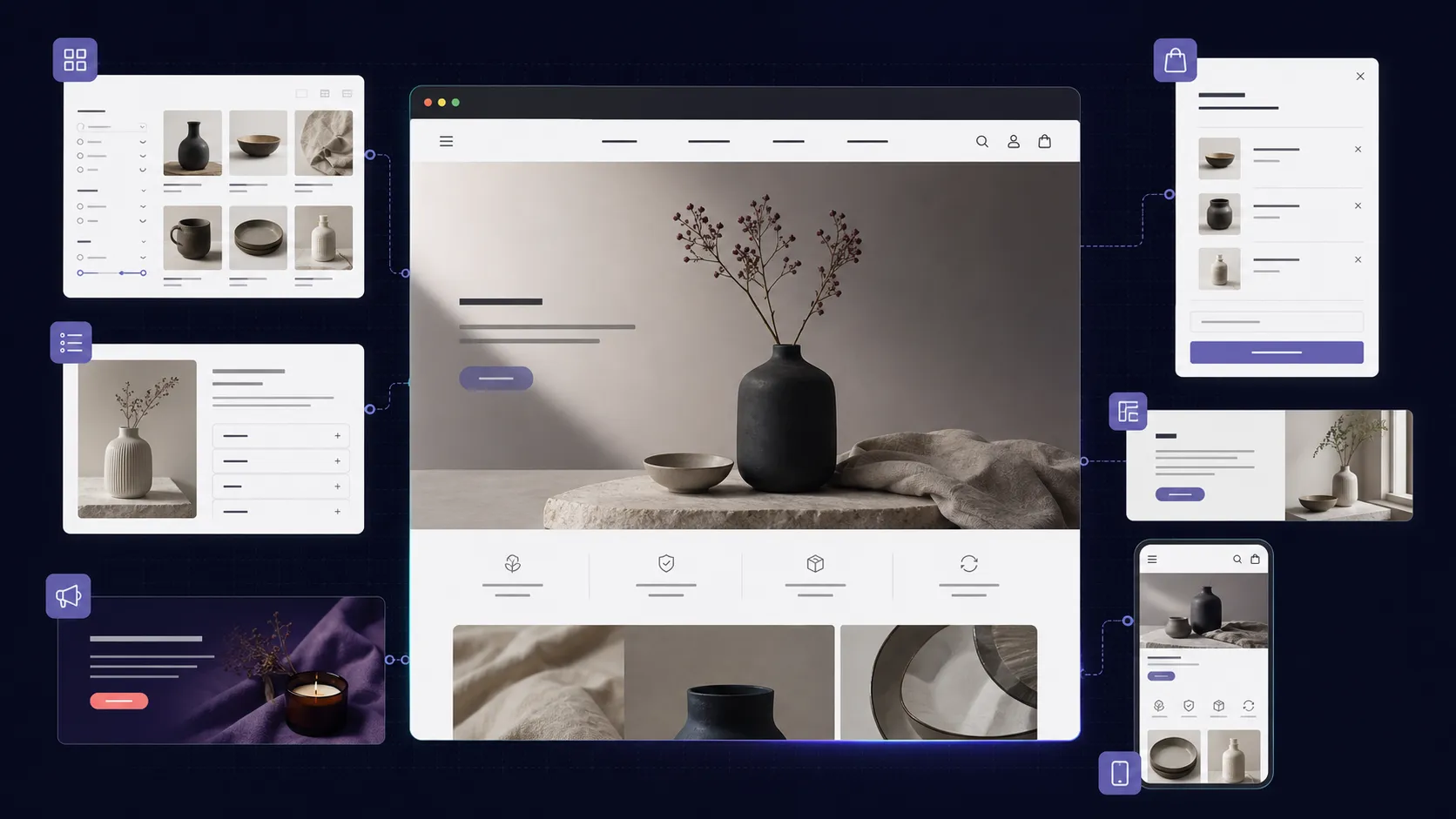
A custom build earns its place when it removes a real constraint: clearer product decisions, stronger merchandising, less app weight, or a faster route to checkout.
Product templates shaped around variants, bundles, ingredients, sizing, subscriptions, specifications, or whatever a confident purchase requires.
Flexible collection, editorial, and landing-page sections that let your team launch a story without rebuilding the storefront.
A consistent visual and interaction system that holds together from the home page to search, product detail, cart, and account.
Lean Liquid, deliberate JavaScript, responsive imagery, and native theme capabilities before another storefront app is added.
Both can be the right answer. We recommend the smallest approach that removes the constraint instead of treating “custom” as the default upsell.
Read the full decision guide| Decision | Customized premium theme | Custom Shopify theme |
|---|---|---|
| Starting point | A proven Theme Store foundation | A design system shaped for your store |
| Best fit | Clear catalog, familiar buying journey, faster launch | Distinct products, merchandising, or customer journey |
| Flexibility | Strong inside the theme’s existing architecture | Components and templates planned around your roadmap |
| Performance | Depends on the base theme and depth of customization | Budgeted into every component from the first build |
| Investment | Lower when the existing foundation already fits | Higher when the foundation itself needs to change |
The visible storefront and the merchant experience are designed together. A polished page is only useful if your team can keep it current.
Type, color, spacing, components, responsive rules, and interaction patterns that make new pages feel like the same store.
Templates built around how customers compare, understand, and choose your products—not a generic feature checklist.
Shopify sections, blocks, metafields, and metaobjects that give the team controlled flexibility without layout drift.
Reviews, subscriptions, search, bundles, loyalty, and analytics placed deliberately so third-party tools feel native to the storefront.
Semantic markup, keyboard paths, visible focus, readable contrast, reduced motion, and layouts tested across the devices customers actually use.
Responsive images, restrained JavaScript, Core Web Vitals checks, browser testing, redirects, analytics, and launch verification.
Strategy, design, development, and launch stay connected. You review working decisions throughout the project rather than discovering the store at handover.
We map what the current theme blocks, what customers need, what the team edits, and which integrations must survive the rebuild.
We shape the core customer journey and reusable components before expanding them across templates.
Working sections and templates land on a preview theme where your team can test real products and content.
We verify devices, browsers, analytics, redirects, apps, and editing workflows, then document the theme for your team.
Built inside Shopify’s native model. Liquid, JSON templates, sections and blocks, metafields, metaobjects, responsive images, Shopify CLI, and Git-based source control.
Need custom workflow logic too?Projects from $3,000
Price moves with template count, product complexity, custom interactions, integrations, and content migration. After one call, you get a written plan, realistic timeline, and fixed quote.
See all project pricingThe product page customers struggle with, the campaign your team cannot launch cleanly, or the theme modification that keeps making the store slower.
The first useful decision is often whether a rebuild is necessary at all.
Not always. If a strong premium theme already supports the way you sell, focused customization may be the better investment. A custom theme makes sense when your merchandising, product experience, brand system, or performance needs keep running into the limits of a template.
Yes. We build with Shopify sections, blocks, templates, metafields, and metaobjects so your team can update products, campaigns, landing pages, and editorial content without calling a developer for routine changes.
Yes. We can audit the current theme and recommend whether to improve it, rebuild parts of it, or replace it. We will not sell a ground-up build when a focused customization solves the actual problem.
Custom theme design and development projects start at $3,000. The final quote depends on the number of templates, product and merchandising complexity, integrations, content migration, and the level of custom design required.
Yes. Performance, semantic HTML, keyboard navigation, visible focus states, responsive behavior, and reduced-motion support are part of the build rather than a cleanup task at the end.
Show us what the current theme cannot do. We will tell you whether to customize it, rebuild part of it, or start fresh—and why.