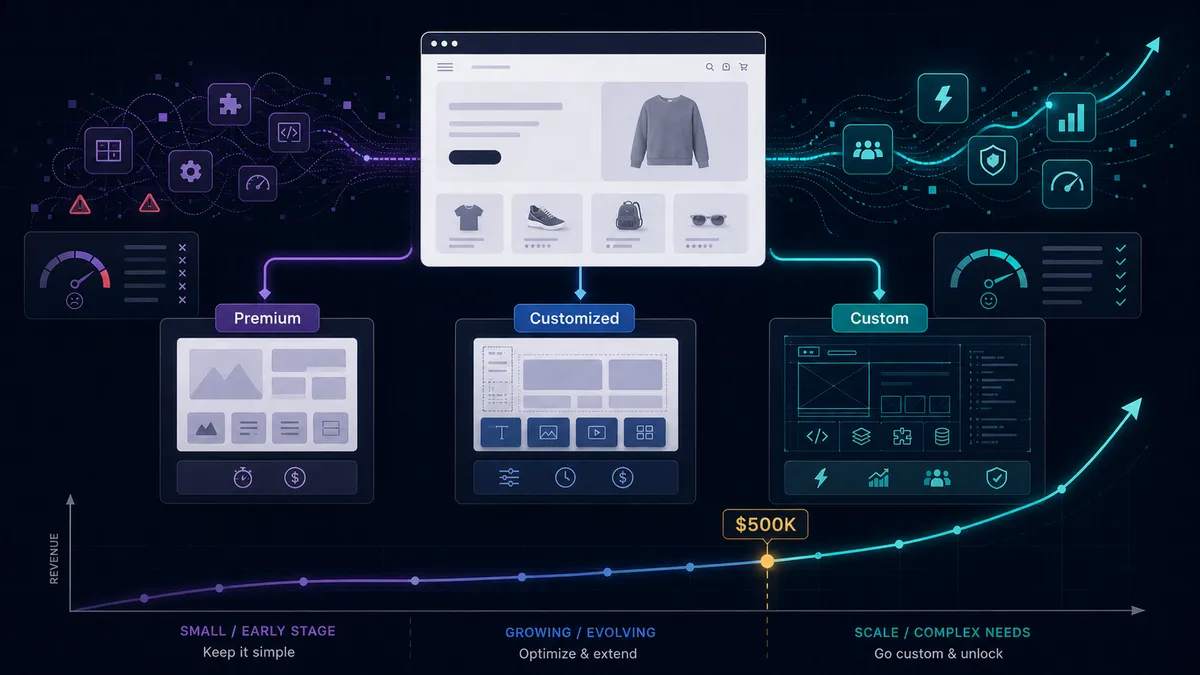
At some point every growing Shopify store asks the same question. Do we keep tuning the theme we bought, or do we pay someone to build one from scratch? It sounds like a design decision. It’s really a money decision, and the honest answer is that custom is the wrong call more often than agencies like to admit.
We build custom themes for a living. We also talk plenty of stores out of them. So let’s do this the useful way. What each option actually is, what each actually costs, and the point where writing the bigger check starts making you money instead of just spending it.
What you’re really choosing between
A premium theme is a professionally built template you license, from the Shopify Theme Store or a marketplace, then configure to your brand. Fonts, colors, sections, your photography. You’re renting a proven foundation and making it yours from the outside.
A custom theme is built for your store specifically. The layout, the components, the way a product page is put together, all of it designed around how you sell and coded to match. Nothing generic underneath. Our custom Shopify theme development service covers the full path from storefront direction and design system through development, testing, and handover.
Here’s the part that gets lost. A well-configured premium theme and a cheap custom job can look almost identical to a shopper. The difference isn’t polish on day one. It’s what happens when you need the store to do something the template never planned for, and whether that moment is worth paying for yet.
What each one costs
Round numbers, because vague ranges help nobody.
A premium theme license runs roughly 200 to 400 dollars, one time. Configuring it well, with real design attention rather than swapping a logo, tends to land somewhere between 2,000 and 8,000 dollars of work depending on how far you push it. That’s your all-in for a storefront that looks sharp and converts fine.
A custom theme is a different order of spend. At PixelSplash, focused custom theme projects start at 3,000 dollars. Larger bespoke builds commonly move past 8,000 dollars and can climb beyond 30,000 for ambitious catalogs and buying journeys. You’re paying for design, development, testing, and someone thinking hard about your specific conversion path. It’s not a markup on the same thing. It’s a different thing.
So the gap is real. Custom can cost ten times what a dialed-in premium theme does. That’s exactly why the revenue question matters more than the taste question.
The revenue line
Here’s the rule of thumb that holds up in practice. Stores doing under about 500,000 dollars a year rarely need a custom theme to compete. A properly customized premium theme converts perfectly well at that stage, and the money you’d sink into custom almost always earns more somewhere else. Ads, product, retention, photography. Spend it there.
Above that line, the math shifts. Brands past 500,000 dollars in competitive categories tend to see real, measurable lifts from custom work, often in the range of 25 to 50 percent on conversion once the storefront is built around how they actually sell. At that volume a few points of conversion is serious money, and the build pays for itself fast enough to justify the number.
The reason is simple. When you’re small, your ceiling is traffic and product, not theme architecture. When you’re bigger, the template itself starts capping you. A percentage point you can’t unlock is suddenly worth more than the entire cost of building custom. The tool has to match the size of the problem.
Signs a premium theme is still the right call
Be honest about where you are. A premium theme is almost certainly enough if:
You’re under that revenue line, or still finding product-market fit. Your catalog is straightforward and your product pages don’t need anything unusual. A premium theme handles it, and your money works harder elsewhere.
You need to move fast. A configured premium theme can be live in days. A custom build is weeks, sometimes months. When speed to market beats bespoke polish, the template wins outright.
Your current theme mostly works and you’re chasing a feeling, not a number. “It feels a bit generic” is not a business case. If you can’t point at a specific thing the theme stops you from doing, you’re not ready to pay for custom yet, and that’s fine.
Signs you’ve outgrown the template
The flip side, the moments that actually justify the spend:
You keep hitting walls the theme won’t move. You want a product page built around a configurator, a bundle builder, a quiz-driven recommendation, and every app duct-taping it on makes the store slower and jankier. When the workarounds cost more than a real build would, the template is now the bottleneck.
Apps are papering over gaps. If you’re paying for five apps to force a template into a shape it was never meant to hold, you’re already spending custom money. You’re just spending it badly, and paying in speed too. We wrote about that trap in the app tax.
Speed is suffering from all the retrofitting. Bloated themes plus stacked apps drag load times, and slow stores lose sales. Sometimes the cleanest fix is a purpose-built theme that does natively what you were bolting on. If the store already feels slow, start with our storefront speed guide before you assume custom is the only answer.
Your brand or your operation is genuinely distinct. Unusual merchandising, a complex catalog, a buying experience that’s part of the product. When the way you sell is a real differentiator, a generic frame undersells it, and custom stops being a luxury.
The middle path most stores actually need
Here’s what agencies rarely tell you, because it sells the least. The real answer for a lot of growing brands isn’t premium or custom. It’s a premium theme, customized hard by people who know what they’re doing.
That means starting from a fast, proven foundation and then doing serious design and development work on top. Custom sections, a reworked product page, real performance tuning, brand details that make it stop looking like the template it started as. You get most of the benefit of custom at a real fraction of the cost, and you keep the stability of a maintained base.
For most stores between “just launched” and “clearly at scale,” that’s the sweet spot. You go full custom when you’ve outgrown even that, when the foundation itself is the thing holding you back.
How to actually decide
Skip the taste debate. Ask three plain questions.
Is there a specific thing your theme won’t let you build, that you can tie to revenue? Are you already spending custom-level money on apps and workarounds to fake it? And are you past the revenue point where a few conversion points outweigh the build cost?
Three yes answers and custom is probably worth it. Mostly no, and your money belongs somewhere else for now. The goal was never the fanciest theme. It’s the storefront that earns the most for what you put into it.
PixelSplash designs, builds, and scales Shopify storefronts for brands that have outgrown their theme. Explore our custom Shopify theme development, or book a free consult if you are not sure whether you have actually hit that wall. 30 minutes, zero pitch, and we will tell you straight.