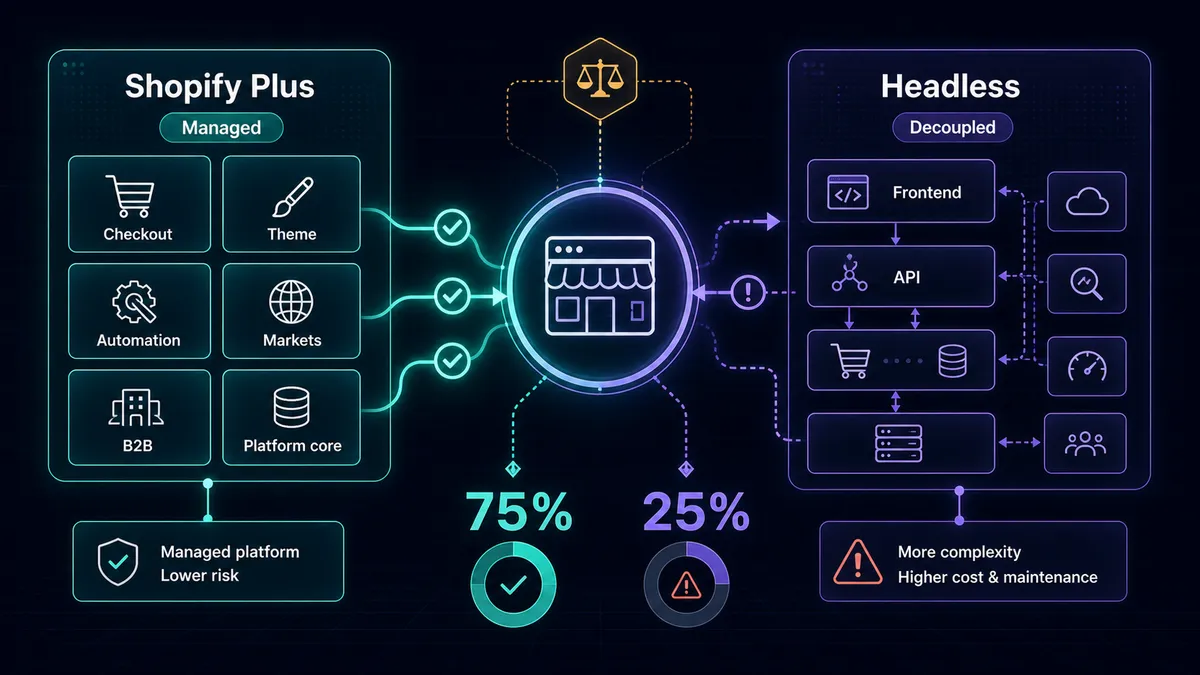
Headless Shopify costs more than a Shopify theme because you are no longer building only a storefront. You are creating and operating a separate frontend application, its hosting, content connections, release process, monitoring, and the glue between those pieces.
That can be the right investment. It can also be an expensive way to solve a problem that a strong Shopify theme or Shopify Plus setup already handles.
The useful comparison is not “basic Shopify versus serious headless.” It is the complete cost of each operating model and the business constraint each one removes.
Headless Shopify and Shopify Plus are not opposites
Shopify Plus is a Shopify plan. Headless is a storefront architecture. A business can use Shopify Plus with a native theme, or use Shopify Plus as the commerce engine behind a headless frontend.
For a practical decision, compare these two operating models:
| Native Shopify or Shopify Plus | Headless Shopify | |
|---|---|---|
| Storefront | Shopify theme using the platform’s native rendering and editor | Separate frontend application using Shopify APIs |
| Initial build | Theme system, templates, extensions, integrations, and migration as needed | Frontend application plus commerce, content, search, hosting, and integration work |
| Releases | Shopify theme workflow | Application deployment pipeline with environments and monitoring |
| Ongoing ownership | Merchant team plus periodic Shopify development | Product and engineering ownership for a custom application |
| Best fit | Most ecommerce journeys, including highly customized stores | Experiences or channels the native storefront model cannot reasonably support |
The plan fee is only one line in either budget. Design depth, migration, integrations, content, search, international requirements, and ongoing development can matter far more.
What a headless Shopify budget actually includes
A credible headless estimate should separate the following work. If a proposal contains only page templates and a frontend framework, it is probably missing part of the operating system the store will need.
1. Experience and frontend engineering
This is the visible application: navigation, collection browsing, search, product pages, cart, accounts, content pages, responsive behavior, accessibility, analytics, and edge states.
Headless gives the team more control over this layer. It also means the team owns more decisions that Shopify normally handles.
2. Commerce integration
Products, variants, pricing, availability, cart, customers, checkout, markets, discounts, and merchandising rules have to move reliably between Shopify and the frontend.
The cost rises when the store has complex product logic, several markets, custom pricing, subscriptions, B2B requirements, or account behavior beyond the ordinary purchase path.
3. Content, search, and preview workflows
Many headless builds add a content system and a dedicated search service. That creates useful editorial freedom, but someone must design the content model, decide which system owns each field, build previews, connect search indexing, and prevent duplicate work for the merchant team.
4. Hosting and operational tooling
A separate application needs environments, deployment, caching, error monitoring, analytics, security updates, and a response plan when a release fails. These are recurring responsibilities, even when the hosting bill itself looks small.
5. Quality assurance and launch
Browser and device testing, redirects, analytics, consent, structured data, performance budgets, accessibility, load behavior, and rollback planning all belong in the scope. A decoupled stack creates more boundaries to test.
6. Ongoing change
Campaign pages, new Shopify features, app changes, content-model updates, browser behavior, and API changes continue after launch. Budget for ownership, not only maintenance emergencies.
The cost comparison that matters
Instead of using one broad headline number, compare the same categories for both options:
| Cost area | Native Shopify or Plus | Headless Shopify |
|---|---|---|
| Discovery | Customer journey, theme, apps, integrations | The same work plus architecture and operating-model decisions |
| Storefront build | Theme and supported platform extensions | Custom application and design system |
| Content | Shopify content model or a limited integration | Often a separate content model, API, preview, and publishing workflow |
| Search | Native or app-based search | Search integration, indexing, result UI, and monitoring |
| Infrastructure | Mostly managed within Shopify | Frontend hosting, deployment, caching, logs, alerts, and environments |
| Team after launch | Merchant team with partner support | Merchant, product, and ongoing engineering ownership |
| Change risk | Concentrated in theme and apps | Spread across frontend, APIs, content, search, hosting, and third parties |
This is why two stores with the same number of pages can have completely different headless costs. Page count is a weak estimator. System boundaries, unique journeys, and operating responsibility drive the scope.
When Shopify Plus is usually the better investment
A native Shopify Plus build is usually the lower-risk choice when the business needs:
- More control around checkout, B2B, markets, automation, or integrations
- A distinctive storefront that still follows familiar ecommerce journeys
- Faster merchandising without engineering every content update
- A smaller technical team and a managed platform boundary
- A performance improvement that can be achieved by fixing media, apps, theme code, or third-party scripts
“We want a faster store” is not, by itself, a headless requirement. Start by measuring the actual bottleneck and fixing ordinary storefront weight. Our Shopify performance guide explains that process.
When headless can earn the extra cost
Headless becomes defensible when at least one important requirement survives a serious native-Shopify review:
- One commerce core must serve meaningfully different web, app, editorial, retail, or regional experiences
- The main customer journey behaves more like a bespoke application than a conventional storefront
- The content model and publishing workflow cannot reasonably fit the theme layer
- A confirmed platform constraint blocks a high-value experience or channel
- The business already has the product and engineering capacity to operate a custom frontend
The last condition matters. A business can afford the build and still be unprepared to own the result.
A safer way to estimate the decision
Use three gates instead of jumping from an idea to a full rebuild.
Gate 1: Write down the constraint
Name the exact journey, workflow, performance limit, content need, or channel requirement the current architecture cannot support. Include evidence: user behavior, team time, revenue impact, or a technical measurement.
If the constraint is vague, the estimate will be vague too.
Gate 2: Compare the smallest viable options
Price at least these paths:
- Improve the current Shopify theme and app stack.
- Rebuild the storefront natively on Shopify or Shopify Plus.
- Build a headless frontend and its operating model.
Compare delivery cost, annual ownership, team requirements, time to value, and the cost of reversing the decision—not just the launch quote.
Gate 3: Prototype the hardest path
Before funding the whole storefront, build or technically validate the part most likely to break the assumption. That might be a product configurator, editorial product discovery, account flow, international catalog, or high-traffic collection.
A small prototype can expose API, content, performance, or workflow limits while they are still cheap to change.
Questions every headless proposal should answer
- What specific native Shopify limitation makes headless necessary?
- Which system owns products, merchandising content, editorial content, search, and customer data?
- How will preview, localization, redirects, analytics, consent, and structured data work?
- Who owns hosting, deployments, monitoring, security updates, and incidents?
- What can the merchant team change without a developer?
- What is included after launch, and what becomes a separate maintenance cost?
- What is the fallback if the key technical assumption fails?
Clear answers do not make a headless build inexpensive. They make the price understandable.
The honest bottom line
Shopify Plus expands what the managed Shopify platform can do. Headless expands what your team must build and own. Sometimes that control unlocks an experience or channel that justifies the cost. Often a better native storefront delivers the business outcome sooner and with less operational drag.
Start with the constraint, compare complete ownership costs, and prove the hardest assumption. If headless still wins, you will have a stronger architecture and a more credible budget.
Our Headless Architecture Review produces that written decision before a full build is scoped.